China's Steel Exports Poised to Hit New Record in 2025, Facing Turning Point in 2026
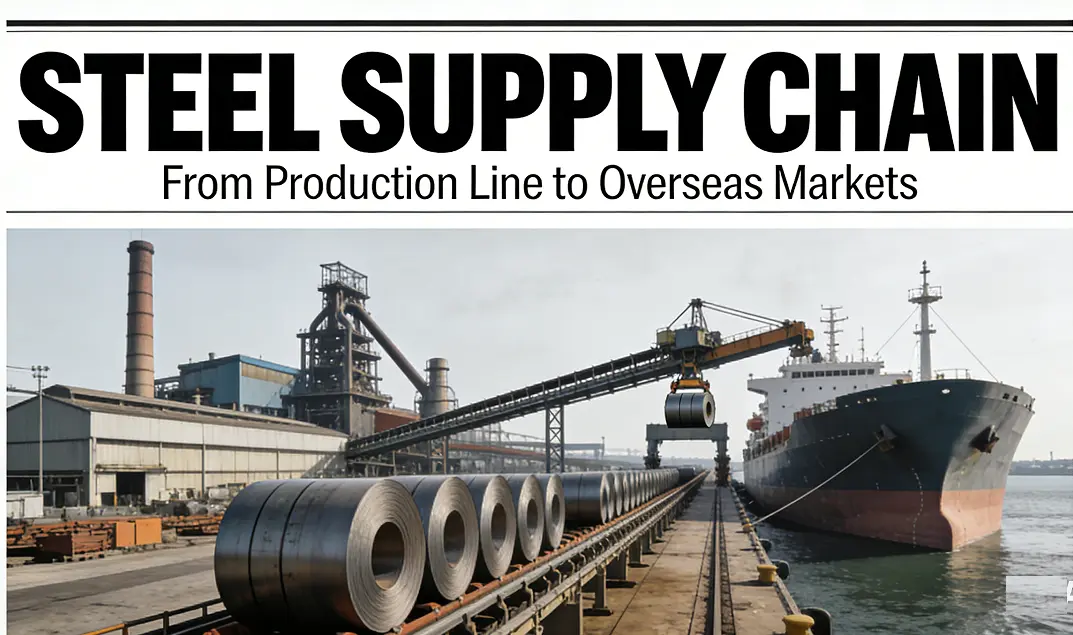
China's steel exports are expected to set a new historical record in 2025, surpassing 115 million tons, In 2024, China's steel exports already reached 111.1 million tons, a year-on-year increase of 23.1%, hitting an all-time high. However, affected by multiple factors such as changes in domestic regulatory policies and adjustments in the structure and direction of export products, 2026 may become a crucial turning point for China's steel exports.
From January to October 2025, Chinese steel enterprises exported a total of 97.7 million tons of steel, a year-on-year increase of 6.2%. According to market data, the export volume in November alone was close to 10 million tons, and the cumulative export volume in the first 11 months exceeded 107 million tons. If the export volume in December remains at about 9.8 million tons, the annual export volume is expected to reach 117.3 million tons.
Structurally, notable changes are taking place in China's steel exports. In the first 10 months of 2025, the export volume of finished steel products increased by 6.2% year-on-year to 97.74 million tons; the main driver of the overall growth came from semi-finished products. During the same period, the export volume of semi-finished products surged by 260% year-on-year to 11.9 million tons. For comparison, China's annual export volume of semi-finished products was 6.3 million tons in 2024 and only 3.3 million tons in 2023.
The rapid growth in exports of billets and slabs stems from a combination of multiple factors. On one hand, anti-dumping and safeguard measures targeting Chinese finished steel products have continued to expand globally. From 2024 to 2025, regions such as Southeast Asia, the Middle East, Latin America, and Europe have successively launched or intensified trade remedy investigations. In many markets, semi-finished products are either not included in the scope of restrictions or subject to significantly weaker constraints than finished products.
On the other hand, exporting semi-finished products helps Chinese steel mills reduce trade risks and transfer part of the profit margin and carbon emission pressure to the downstream processing link. This is particularly important against the backdrop of the EU Carbon Border Adjustment Mechanism (CBAM) having entered the implementation stage and being fully rolled out. Although CBAM already covers semi-finished products, its actual financial impact is still lower than that of high-value-added finished steel products, making the export of semi-finished products a relatively safe overseas sales channel.
At the same time, domestic demand for steel in China remains sluggish, especially in the construction and infrastructure sectors, exerting pressure on the capacity utilization of steel mills. By exporting semi-finished products, steel mills can quickly release production capacity without having to seize the market through large-scale low-price dumping of finished products, thereby reducing the risk of trade frictions.

745.webp)